

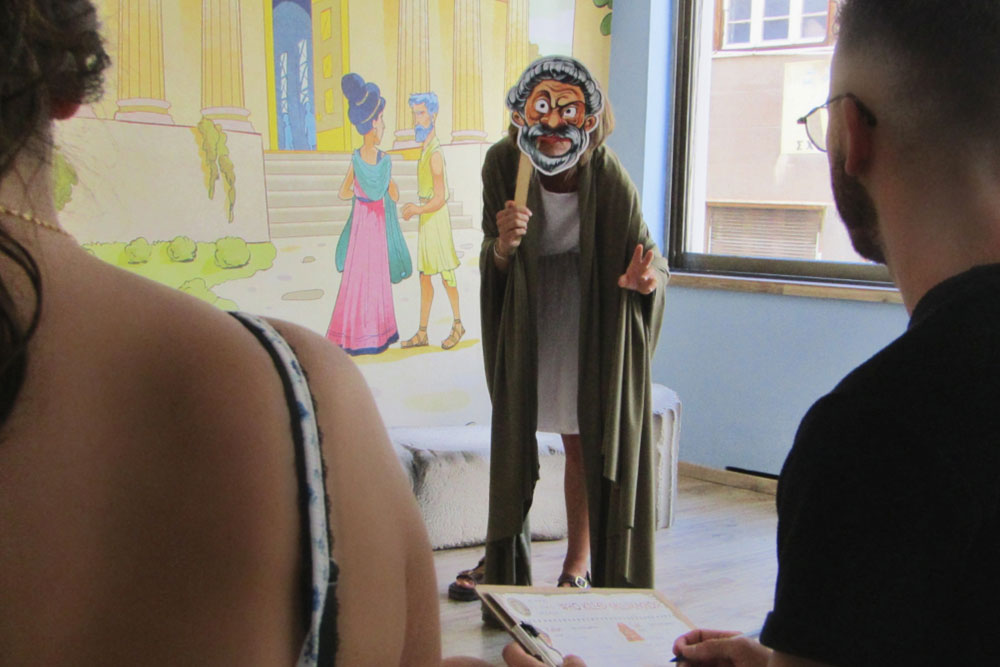
An evening mystery game in Athens puts you inside a live investigation instead of watching one from a seat. Athens Living Museum runs its version around Who Killed Callimachos, a daily show where guests help a fictional detective named Nikarchos question suspects and solve an ancient Athenian murder.
The venue sits indoors near Monastiraki, air-conditioned and step-free at the entrance, with one actor playing several suspects across the evening. No prior knowledge, costumes, or detective skills are required. Guests just show up, listen, ask questions, and try to work out the truth before the actor reveals it.
Booking any interactive show blind can feel risky. Knowing what actually happens once you walk through the door removes most of that uncertainty and helps you decide if the format fits your group.
What Happens During an Evening Mystery Game Before You Book?
The show runs every day at a fixed evening time, keeping the format predictable for travelers planning a tight schedule. Guests arrive at the venue near Monastiraki metro station, where a team member greets them at the entrance.
Once inside, the story begins almost immediately. There is no lengthy introduction or safety briefing. Detective Nikarchos sets the scene, and guests quickly learn they are part of the investigation, not spectators watching one unfold.
From there, the format stays consistent throughout. Guests meet suspects, ask questions, gather clues, and slowly build their own theory about who committed the crime. The evening ends with a reveal, tying every clue back to the actual culprit.
Meeting the Characters Behind the Mystery
A single actor typically plays every suspect across the evening, shifting voice, posture, and personality between characters. That range is part of what makes the show feel alive rather than scripted from start to finish.
Guests interrogate each character directly, asking questions shaped by whatever theory they are building at the time. Answers shift slightly depending on what guests ask, which keeps the pacing responsive rather than fixed.
This structure rewards genuine curiosity. Guests who ask specific, pointed questions tend to get more useful clues than those who stay quiet and simply watch the scene unfold around them.
Why the Name Callimachos Carries Real Historical Weight?
The mystery’s victim, Callimachos, is fictional within the story, but the name echoes a real historical figure, Callimachus of Cyrene, a respected poet and scholar from the Hellenistic era. That connection adds a layer of authenticity beyond the invented plot.
The real Callimachus worked in Alexandria among some of antiquity’s most influential thinkers, and referencing his name grounds the fictional mystery in genuine Greek intellectual history. Guests do not need to know this background to enjoy the show, but it rewards those who do.
This blend of invented plot and real historical texture is a deliberate choice. It keeps the evening entertaining while still respecting the deeper Greek history the format draws from.
Who the Show Actually Suits?
Solo travelers often assume interactive formats work better in groups, but the show accommodates individuals comfortably, since guests get folded into a larger investigation regardless of how they arrived. Couples and small friend groups tend to enjoy the shared problem-solving element most.
Families with children also do well here. The show stays intentionally light-hearted despite its murder theme, avoiding anything that would frighten younger guests while still keeping adults genuinely engaged. For more ideas along these lines, the guide to family activities in Athens covers several similar formats.
Corporate groups occasionally book the show as an alternative to standard team building. The structure lends itself naturally to this use, closely related to the dedicated corporate team building in Athens sessions built around the same mystery.
How Long the Experience Runs
Most sessions run for roughly ninety minutes to two hours, covering the full arc from introduction to final reveal. Rushing through the interrogation phase generally reduces how satisfying the ending feels, so plan for the full runtime rather than a quick stop.
Guests should expect to stand, sit, and move around slightly throughout the show, depending on how the scenes are staged. Comfortable footwear helps, though the format stays accessible for most visitors without special preparation.
Because the venue is fully indoors and air-conditioned, weather has no impact on the evening. That reliability makes it a solid option regardless of season or forecast.
What to Bring and What to Expect on Arrival
No special preparation is needed before attending. Guests do not need costumes, props, or prior detective experience, since the format explains itself naturally as the story unfolds.
Tickets are usually shown as a smartphone confirmation at the entrance, and staff typically greet guests directly rather than requiring a formal check-in process. Arriving a few minutes early helps avoid missing the opening scene, since the story starts close to the scheduled time.
The venue includes step-free access at the entrance, with an elevator or stairs available inside. Guests with mobility needs should confirm specific accessibility details directly when booking.
How This Compares to Other Interactive Formats
Escape rooms and mystery games often get grouped together, but they work differently. Escape rooms rely on physical puzzles within a locked space, while this format relies on conversation, character interaction, and live performance.
Guests who enjoy talking through clues and reading people tend to prefer the mystery show format, while those who enjoy hands-on puzzle-solving may lean toward escape rooms instead. The detailed breakdown in murder mystery vs escape rooms covers this comparison in more depth.
Neither format is objectively better. The right choice depends entirely on what kind of interaction your group actually enjoys during a night out.
Why the Format Rewards Genuine Participation
Guests who treat the evening like a passive show tend to get less out of it than those who lean into questioning suspects directly. The actor responds to specific, pointed questions with more useful detail than to vague or hesitant ones.
This dynamic mirrors how ancient Athenian society approached truth and judgment, through dialogue and direct questioning rather than a single authority delivering answers. The format channels that same spirit into a modern, playful setting.
Groups that split up questioning duties, with different guests focusing on different suspects, often piece together the mystery faster than those who let one person do all the talking. Sharing the investigative work tends to make the evening more enjoyable for everyone involved.
Booking Tips Worth Knowing
Since the show runs daily at a fixed time, availability can fill quickly during peak travel season. Booking a few days ahead, or earlier for larger groups, helps secure a specific date without last-minute scrambling.
Group size affects the dynamic slightly, since smaller groups often get more direct interaction with the actor throughout the evening. Larger groups still work well, though guests may need to be a bit more assertive to get involved in questioning suspects.
Travelers curious about the deeper story behind the mystery format can read the full background in the piece on the immersive mystery game hidden in Athens, which explores its historical inspiration further.
First-Time Visitors Can Book Without Hesitation
Travelers new to Athens sometimes assume interactive formats require familiarity with the city first. This show works just as well on a first visit, since no prior context about Athens or Greek history is required to follow along.
For a broader view of where this experience fits into a first trip, the guide to best Athens experiences for first-time visitors outlines several bookings worth locking in ahead of arrival.
Bringing It All Together
An evening mystery game in Athens turns a standard night out into an active investigation, built around real interaction rather than passive viewing. Knowing what to expect, from the venue to the characters, makes booking an easy decision.
If you want a night in Athens built around genuine participation, book Who Killed Callimachos at Athens Living Museum. Meet Nikarchos, question the suspects, and see if you can solve the case before the truth comes out.
Frequently Asked Questions
What is Who Killed Callimachos?
It is a live, interactive murder mystery show in Athens where guests help a fictional detective question suspects and solve an ancient crime through clues and conversation.
Do I need any prior experience to join the mystery game?
No prior experience is needed. The format explains itself naturally as the story unfolds, and staff guide guests through the process from the start.
Is this evening mystery game suitable for children?
Yes. The show stays light-hearted despite its murder theme, avoiding frightening content while keeping the story engaging for both children and adults.
How long does the show typically last?
Most sessions run between ninety minutes and two hours, covering the full investigation from the opening scene through the final reveal.
Is the venue accessible for guests with mobility needs?
The venue offers step-free entry with elevator access inside, though guests with specific mobility needs should confirm details directly when booking.
How is this different from an escape room?
The mystery game relies on live performance and conversation with characters, while escape rooms focus on physical puzzles within a locked space.
