


Athens is a city layered with stories. Some are carved in marble, others hidden in manuscripts, and a few come alive in ways most visitors never expect. One of the most intriguing is Who killed Callimachos?, an immersive mystery game tucked away in the historic heart of the city. It is not a standard museum visit, nor a typical escape room. It is a living story that places you inside an ancient crime and asks you to uncover the truth.
For travelers seeking experiences beyond landmarks, this interactive mystery blends performance, history, and participation into something memorable. Visitors staying through Athens Living Museum often look for meaningful cultural activities, and this experience offers exactly that: entertainment with depth, rooted in ancient Greek tradition but told in a modern, engaging way.
Rather than simply asking how did Callimachos die, the experience challenges you to think, question motives, and interpret clues, just as an Athenian citizen might have done centuries ago. It transforms history into something personal and participatory.
Athens has always been a city of debate, inquiry, and storytelling. This immersive mystery captures that spirit and invites you to become part of it.
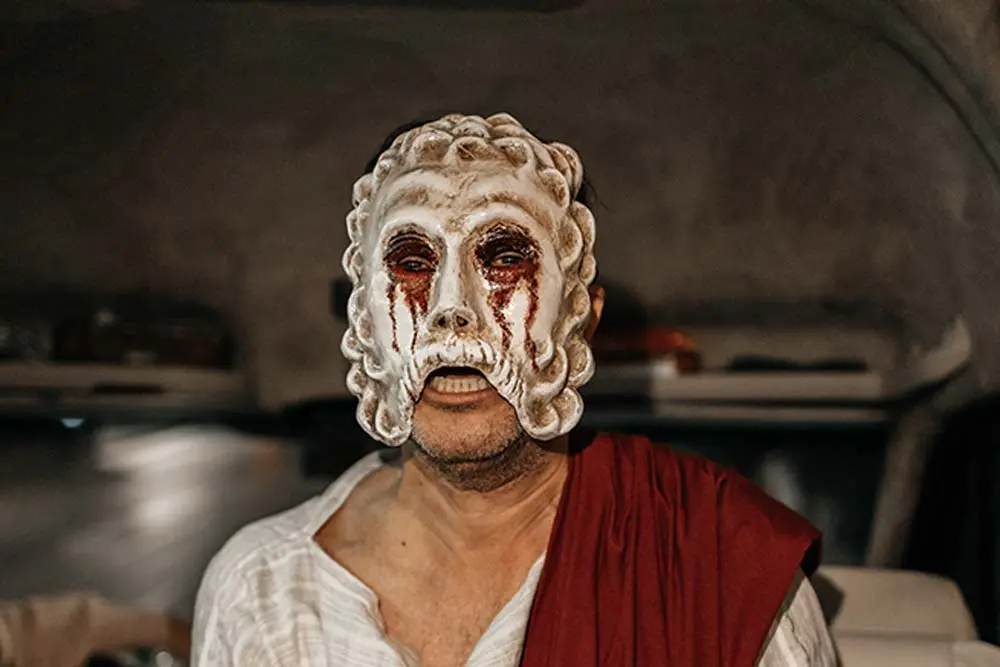
Who killed Callimachos? An ancient mystery brought to life
The question Who killed Callimachos? is the foundation of a theatrical investigation that unfolds before your eyes. From the moment the experience begins, you are no longer a passive observer. You are a participant in a crime that echoes through ancient Athens.
The story is set in classical times and revolves around the sudden death of Callimachos, a respected citizen whose life was closely connected to the social and political fabric of the city. Rumors spread quickly. Suspects emerge. Motives conflict. Nothing is as simple as it seems.
Participants are guided through the mystery by characters who represent figures from ancient Athenian life. Through dialogue, observation, and collective reasoning, the audience works together to piece together what really happened. The question of who was responsible for Callimachos death becomes more complex as new information is revealed.
Unlike scripted theatre, this experience reacts to the audience. Discussions, questions, and decisions shape how the mystery unfolds. Each performance feels unique, driven by the people in the room and the conclusions they reach.
This approach reflects the democratic and philosophical nature of ancient Athens, where truth was often sought through dialogue rather than authority.
History, fiction, and the power of storytelling
While the immersive mystery centers on a fictional narrative, it draws inspiration from real historical contexts. The name Callimachos immediately evokes associations with Callimachos of Cyrene, the renowned ancient Greek poet and scholar from the Hellenistic era.
The historical Callimachus lived during the Ptolemaic period of Greece and worked in Alexandria among some of the greatest minds of antiquity. As one of the most influential Alexandrian scholars, he reshaped Greek poetry with his emphasis on precision, learning, and refined expression.
The mystery game does not claim to depict his actual life or Callimachos death. Instead, it borrows the intellectual atmosphere of ancient Greek society, where ideas, reputations, and rivalries mattered deeply. The fictional Callimachos exists within that world of tension, ambition, and social complexity.
This blend of fact and fiction helps participants understand how stories were used in ancient Greece. Myths, plays, and philosophical dialogues often explored moral questions through imagined scenarios. The immersive mystery follows that same tradition.
By engaging with the story, players gain insight into how ancient Athenians thought about justice, responsibility, and truth.
Investigating the murder of Callimachos
As the investigation progresses, the murder of Callimachos reveals layers of personal conflict and public consequence. Every suspect has something to hide. Every clue raises new questions.
Rather than relying on physical puzzles alone, the experience focuses on observation, reasoning, and dialogue. Participants listen carefully to testimonies, compare accounts, and challenge contradictions. It mirrors the way legal disputes and public trials once unfolded in the Athenian agora.
The pacing allows time for reflection. Short scenes are followed by discussion, encouraging participants to form theories about how did Callimachos die and why someone would want him gone.
This slow unfolding creates suspense without relying on spectacle. The mystery feels human, grounded in relationships and motivations rather than dramatic effects.
For many participants, the most surprising aspect is how emotionally invested they become. Solving the mystery stops being about winning and becomes about understanding the people behind the crime.
Ancient Greek poet Callimachos and his legacy
The name Callimachos carries weight in Greek cultural history. The real ancient Greek poet Callimachos was known for his sharp intellect and lasting influence on literature. His work shaped poetic standards for centuries and influenced Roman poets such as Virgil and Ovid.
Living in Alexandria rather than Athens, Callimachos of Cyrene represented a shift in Greek culture toward scholarship and textual refinement. His world was one of libraries, scrolls, and intellectual debate rather than political assemblies.
The immersive mystery uses this historical resonance to deepen the story. Even without direct reference, the idea of a learned, respected figure whose death disrupts society reflects how knowledge and reputation mattered in ancient Greece.
Understanding this background enriches the experience. Participants recognize that the mystery is not only about a crime but about the fragile balance of honor, influence, and power.
It also highlights how Greek culture valued questions as much as answers, a principle at the heart of the experience.

Why immersive history works so well?
Traditional historical experiences often rely on observation. You read plaques. You listen to guides. You move on. Immersive storytelling changes that dynamic completely.
By placing you inside the narrative, the mystery turns history into something lived rather than learned. You are not told what to think. You are invited to decide.
This approach aligns with the educational philosophy of experiential learning. When people actively engage with material, retention and understanding increase dramatically.
Athens is the perfect setting for this type of experience. It is a city where drama, philosophy, and civic participation were born. The immersive mystery feels less like an attraction and more like a continuation of that tradition.
For visitors who have already explored sites like the Acropolis or Plaka, this offers a different way to connect with the past.
A cultural experience beyond sightseeing
The mystery also works as a social experience. Participants collaborate, debate, and laugh together. Strangers quickly become teammates united by a shared goal.
This makes it ideal for couples, families, and small groups. It also appeals to solo travelers who want to connect with others through a meaningful activity.
The setting and performance style keep the experience accessible. No prior knowledge of Greek history is required. The story explains itself through action and dialogue.
Those interested in deeper historical context can later explore related exhibitions and educational programs available through the Athens Living Museum, where interactive storytelling is used to bring ancient culture closer to modern audiences.
The mystery becomes a gateway rather than a standalone event.
The question that stays with you
By the end of the experience, a conclusion is reached. A suspect is identified. The case is closed. Yet many participants leave still thinking about the choices they made and the reasoning behind them.
That lingering reflection is part of the design. Ancient Greek stories often aimed to provoke thought rather than provide certainty.
The question Who killed Callimachos? becomes symbolic. It represents the search for truth in a complex world where perspectives differ and motives overlap.
This is what elevates the experience from entertainment to something more meaningful.
Final thoughts and invitation
“Who killed Callimachos?” is not just a mystery to solve. It is an invitation to experience Athens as ancient citizens once did, through conversation, reasoning, and shared storytelling.
It offers a refreshing alternative to conventional tours while remaining deeply rooted in Hellenistic Greece history and cultural tradition.
If you are planning your time in Athens and want an experience that combines history, interaction, and memorable storytelling, this immersive mystery deserves a place on your itinerary.
Step into the story. Ask questions. Draw conclusions. And discover how alive ancient Athens can still feel.
FAQ
Is Who killed Callimachos based on a real historical event?
The story is fictional but inspired by ancient Greek society and historical figures such as Callimachos of Cyrene.
Do I need knowledge of Greek history to enjoy it?
No prior knowledge is needed. The experience is designed to be accessible and engaging for everyone.
How interactive is the mystery?
Participants actively question characters, discuss evidence, and help determine who was responsible for Callimachos death.
Is the experience suitable for families?
Yes, it is designed to be engaging and appropriate for a wide range of ages.
Why is this different from an escape room?
There are no time pressures or physical puzzles. The focus is on storytelling, reasoning, and participation.
