

What did it mean to be educated in ancient Greece? Athens Living Museum explores this fascinating topic through vivid storytelling and immersive workshops in Athens. At the Athens Living Museum, you’ll find the past brought to life, from symposiums to classical education. One of the most influential legacies of ancient Greece is its approach to learning, which shaped Western philosophy, politics, and civic life.
In this post, we’ll explore how the ancient Greek education system functioned, from Athenian ideals to Spartan discipline, and how different forms of schooling reflected the values of the city-states that developed them.
Ancient Greek Education System: Athens vs. Sparta?
Education in ancient Greece was far from uniform. Each polis, or city-state, had its own customs and philosophies. The most well-known systems are those of Athens and Sparta, which could not have been more different in their approach.
In Athens, education focused on intellectual development, public speaking, and the arts. In contrast, Sparta emphasized military training, obedience, and physical endurance. This divergence formed the foundation of what we now call the Spartan agoge vs. Athenian schooling debate.
While formal schools began to appear around the fifth century B.C., education initially took place at home or through private tutors, often slaves. Only wealthy families could afford such training for their sons. Girls, for the most part, were educated at home in domestic skills.
Athens vs. Sparta: How Did Their Education Systems Differ?
To understand the ancient Greek education system, you have to look at what each society valued most. Athens wanted to produce democratic citizens; Sparta wanted to produce unstoppable soldiers.
| Feature | Athenian Education System | Spartan Education System |
|---|---|---|
| Primary Goal | To cultivate well-rounded citizens for democratic and civic life | To produce disciplined, strong, and highly loyal soldiers |
| Who Was Educated | Freeborn boys (via private tuition paid by families) | All boys and girls (state-funded and state-run) |
| Key Curriculum | Literature, music, rhetoric, mathematics, and athletics | Combat training, physical endurance, and absolute obedience |
| Style of Schooling | Academic schools, music halls, and physical gymnasiums | The Agoge—a rigorous, military-style training camp |
| Role of Girls | Educated at home in domestic skills and household management | Trained publicly in athletics, running, wrestling, and gymnastics |
Athenian Paideia: Liberal Arts in Ancient Greece
The Athenian model of education was guided by the concept of paideia, which meant more than just schooling. It referred to the full development of the ideal citizen: morally upright, intellectually capable, physically fit, and artistically literate.
The Athenian paideia liberal arts education in ancient Greece included subjects like reading, writing, music, poetry, athletics, and later, philosophy and rhetoric. Memorization played a vital role. As the philosopher Xenophon recounts, some students memorized the entire Iliad and Odyssey, over 27,000 lines of poetry.
This was not education for its own sake, but for active participation in civic life. Understanding the paideia meaning in the ancient Greek education system is crucial to appreciating how the Athenians linked knowledge to democracy.
Spartan Agoge: Military Schooling in Ancient Greece
The Spartan agoge, military schooling in ancient Greece, was starkly different. At age seven, boys left their families and entered a state-run system designed to create obedient soldiers. Reading and writing were minimal; the focus was on physical fitness, endurance, combat skills, and loyalty to the state.
Even speech was trained for brevity and impact, what we now call “laconic” communication (named after Laconia, the region of Sparta). While Athenians admired eloquence, Spartans prized silence and action.
Understanding how the ancient Greek education system worked in Athens and Sparta helps us grasp the cultural split between intellectual democracy and martial aristocracy.
Ancient Greek Primary and Higher Education Institutions
In Athens, formal schooling began around age seven. Boys studied grammar, music, and physical training in small private schools. By age 16, the wealthiest families sent their sons for tertiary education, often centered on rhetoric and philosophy, skills needed for public life.
These ancient Greek primary and higher education institutions weren’t centralized like today’s schools. Instead, education was informal, relying on individual teachers and tutors. The professions of these teachers often lacked status; many were enslaved people or foreigners. Yet their influence was profound. They shaped generations of thinkers who would go on to influence global thought.
Role of Sophists in Ancient Greek Higher Education
Sophists played a key role in the evolution of Greek education. These itinerant teachers offered training in argumentation, ethics, and logic—for a fee. While respected by some, they were criticized by figures like Plato for teaching persuasion over truth.
Still, the role of Sophists in ancient Greek higher education cannot be overlooked. They popularized critical thinking and public discourse, and their teachings laid the groundwork for modern debate and legal systems.
What Did Athenian Boys Learn in School?
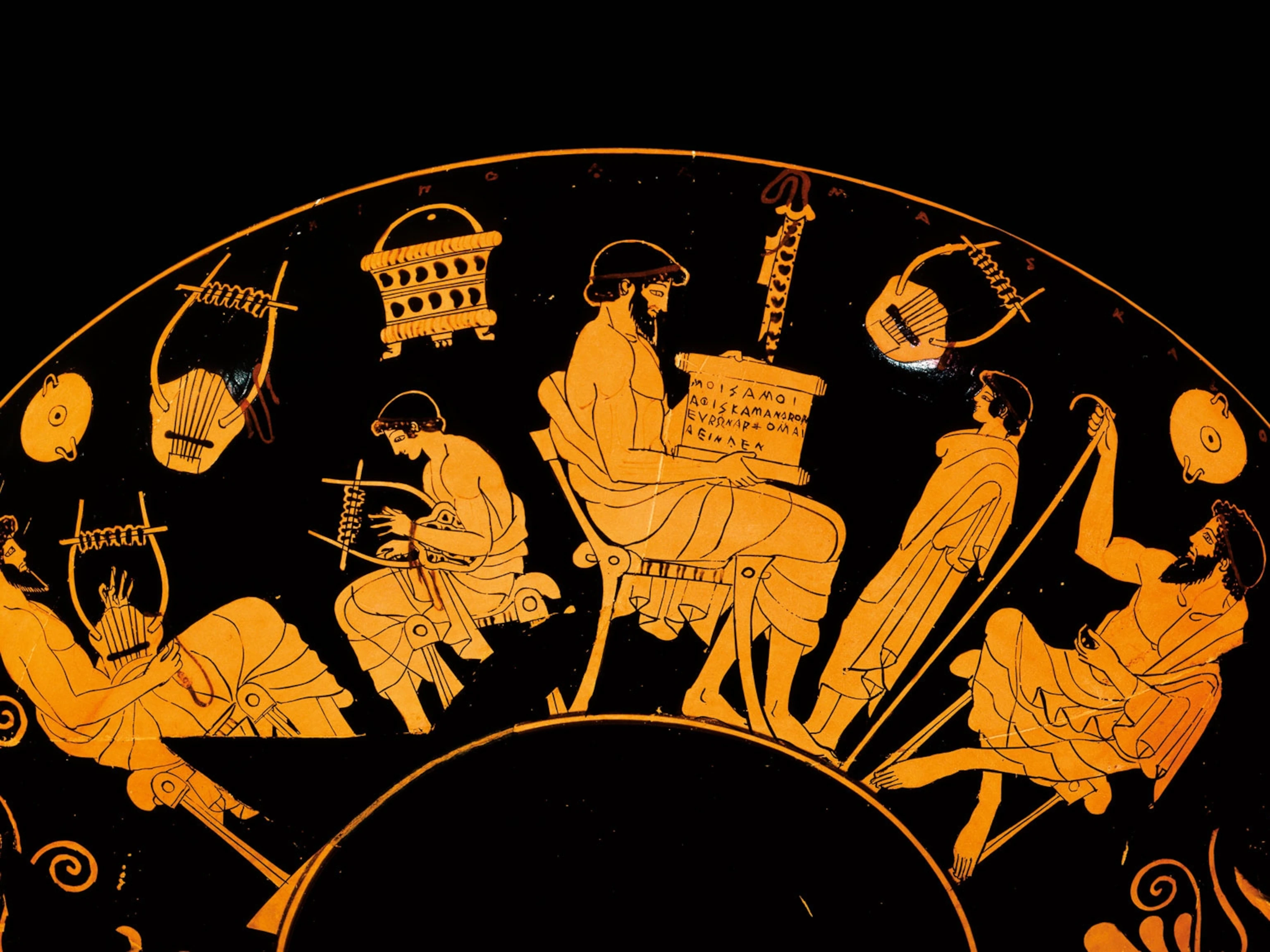
The education curriculum in classical Athens for boys was balanced to nurture both the mind and the body. It relied on three main types of educators: the Grammatistes (for reading, writing, and literature), the Kitharistes (for music and lyric poetry), and the Paidotribes (for physical education).
- Grammar and literature: Reading, writing, arithmetic, and mastery of Homer’s epic poems.
- Music and lyre playing: Learning to sing and play instruments, which was considered a sign of a refined gentleman.
- Physical education: Running, wrestling, and training in the gymnasium to keep the body fit for military service.
- Philosophy and logic: Introduced later (especially from age 16 onward) to develop critical thinking.
- Rhetoric: The art of public speaking, which was essential for political and legal engagement in democratic Athens.
FAQ: Quick Facts About Ancient Greek Education
These answers address the most common questions, homework prompts, and historic debates regarding how Athenian and Spartan children were raised.
Q: An Athenian education focused on preparation for which role?
A: An Athenian education focused primarily on citizenship. Unlike Spartan education, which was designed purely for military training, Athens built its curriculum to prepare young men to actively participate in democratic government, public debate, the arts, and community leadership.
Q: What was the chief goal of education in Athens?
A: The chief goal of education in Athens was to produce well-rounded, virtuous, and capable citizens who could govern the democratic polis (city-state). Athenians believed that a balanced education in both the liberal arts and physical training benefited the public state just as much as it did the individual.
Q: Did girls go to school in ancient Greece?
A: In Athens, girls did not attend formal schools and were educated at home by their mothers in domestic duties, homemaking, weaving, and basic literacy. In Sparta, girls did not go to academic schools but did receive state-mandated public education focused on rigorous physical fitness, athletics, and running to ensure they would grow up to be strong mothers of Spartan soldiers.
Q: How did Athenians educate their children compared to Spartans?
A: Athenians educated their boys privately through a broad liberal arts curriculum (focusing on literature, music, and athletics) to cultivate civic-minded citizens. Spartans educated all children through a state-run military system (Agoge) that focused strictly on obedience, survival skills, combat training, and physical fitness.
Live the Lessons of Ancient Greece Today
At the Athens Living Museum, you can step into the shoes of a young Athenian scholar or Spartan cadet. Our interactive experiences recreate the atmosphere of ancient schools, symposia, and debates.
One such event is our live mystery, where education meets entertainment in an immersive setting that brings ancient daily life to light. This is one of the best things to do in Athens, blending storytelling with historical insight.
