

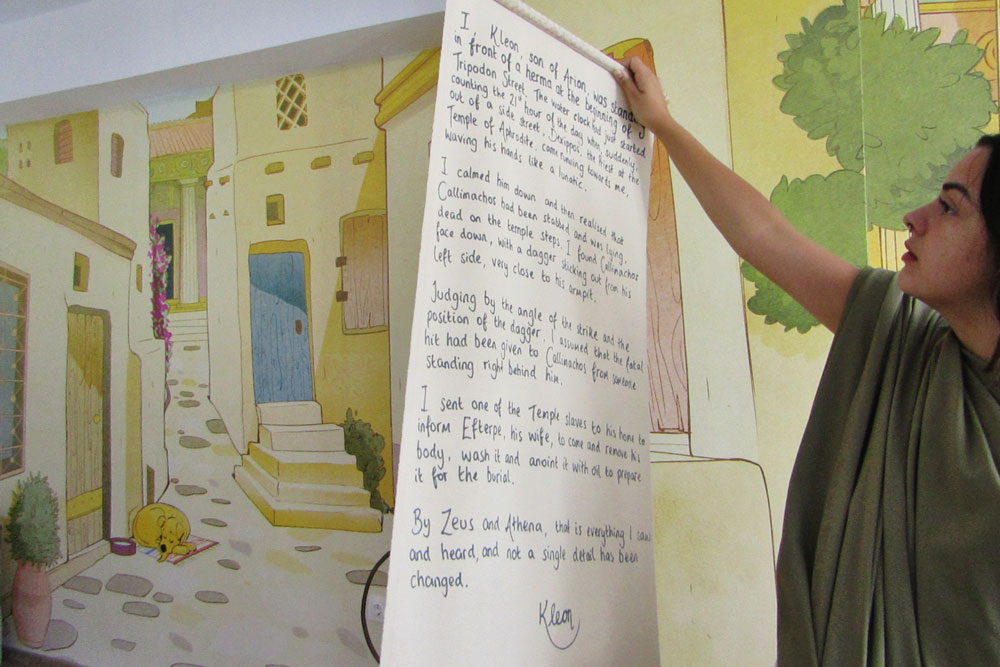
The standard corporate dinner puts colleagues in chairs and hopes conversation happens. Who Killed Callimachos? puts them inside a 5th century BC murder investigation at 22 euros per person, where teams interrogate suspects, trade clues, and solve the case together. Groups of 10 or more can book privately. The dinner feeds people. The mystery makes them a team.
The Problem With the Standard Corporate Dinner
Every HR manager knows the shape of the evening. A long table. Name cards. Polite small talk that follows the org chart: juniors talk to juniors, the same three extroverts carry the table, and half the group checks their phones under the linen. The food might be excellent. The team leaves exactly as siloed as it arrived.
The dinner fails as team building for a structural reason, not a catering reason. It asks nothing of the group. There is no shared task, no time pressure, no reason for the quiet analyst to speak to the sales director. Conversation is optional, and optional conversation follows the path of least resistance.
Real team building needs a forcing function: a task that cannot be completed alone, a clock that cannot be ignored, and roles that cannot be assigned by job title. That is what an interactive mystery format provides, and it is why the format keeps getting booked for offsites, kickoffs, and year-end events in Athens.
What “Who Killed Callimachos?” Actually Is
Strip it to the mechanics. Every day at 6pm, guests step into ancient Athens as detectives investigating a murder. They join forces with Nikarchos, a fictional ancient police officer, meet a cast of suspects, interrogate them, gather clues, and work the case toward a solution. One talented actor plays multiple characters, the groups stay small and intimate, and the story mixes a fictitious murder plot with genuine historical detail about daily life in ancient Athens.
The published facts, taken from the show’s own page: it runs daily at 6pm in an air-conditioned indoor venue, performed in English, family-friendly in tone, and priced at 22 euros per person, with children 5 to 14 at 15 euros and under-5s free. Private bookings and group discounts are offered for groups of 10 or more, arranged by direct contact. Everything needed for the investigation, clues and interactive elements, is provided. Guests bring only curiosity. The result is a greek mythology experience that behaves like a team sport: everyone inside the story, nobody on the sidelines.
The venue also runs a street-level variant of the concept through Plaka, where teams split up, question in-character locals across the old neighborhood, and race to name the culprit, as described in the venue’s own piece on corporate team building in Athens: solve Who Killed Callimachos together. Corporate planners should confirm which format fits their group when booking: the daily 6pm indoor show, or the team-based outdoor investigation.
Why the Mystery Format Builds Teams and Dinner Does Not
Compare the two evenings across the dimensions that actually matter to an HR manager.
The skills point deserves emphasis. A mystery investigation is a compressed model of knowledge work. Clues arrive fragmented across the team. Someone must ask the right questions of the suspects. He must track which theories are dead. Someone must synthesize. These are the exact behaviors companies pay consultants to develop, and the game produces them in two hours because the fiction gives people permission to act.
Nobody at a dinner volunteers to lead. In a murder investigation, someone always does, and it is frequently not the person with the senior title. That single observation is worth the ticket price to most managers.
The Mechanics That Matter for Planners
Practical details decide whether an event works. Here are the ones that matter for this format.
Group size and splitting. The venue offers private bookings for groups of 10 or more. The format scales because investigating teams compete within the same story: a department of 12 and a retreat of 80 can both participate, since the game naturally divides into smaller units. Confirm the maximum comfortable headcount for your preferred format when you book.
Timing. The daily public show runs at 6pm, which slots neatly after a conference day and before a late dinner. Corporate groups wanting a private arrangement should discuss timing directly with the venue; the 6pm slot is the published schedule, and deviations are a negotiation.
Language and accessibility. The performance is in English, which suits international teams. The indoor venue is air-conditioned, removing weather from the risk register entirely. The tone is light-hearted and family-friendly, so it works for mixed groups without the awkwardness that edgier entertainment formats can create.
What is included. Clues, puzzles, and all interactive elements are provided. There is no preparation homework, no app to download, no equipment to rent. For planners, that means one less vendor, one less briefing document, and one less thing that can break.
Food. The mystery ticket does not include dinner. Plan accordingly: the 6pm timing makes it a natural pre-dinner activity, and the venue’s own culinary experience, Around Greece in Five Dishes, can extend the evening for groups that want food and theatre in one booking.
How It Compares to the Other Usual Options
Corporate planners hunting for unusual things to do in Athens typically choose between four formats: the dinner, the cooking class, the boat trip, and the escape room. Each has a failure mode.
The dinner fails on interaction, as described above. The cooking class works for 12 people and collapses at 40, because kitchen stations do not scale. The boat trip is weather-dependent and mostly passive: people sit, look at water, and talk to whoever is nearest. The escape room is the closest competitor, and it deserves a direct comparison.
Escape rooms lock small teams in a room with puzzles. They are genuinely collaborative, but they cap at 6 to 8 people per room, which means a 40-person group fragments across five rooms with five different experiences and no shared story afterward. The mystery format keeps the whole group inside one narrative while still splitting into competing teams. Everyone argues about the same suspects at dinner afterward. That shared story is the difference between an activity and a memory.
For a longer treatment of the comparison, see what makes Who Killed Callimachos different from an escape room and the broader argument for why interactive theatre beats a typical office outing.
The Planner’s Checklist
Eight weeks out. Fix the headcount range and the date. Contact the venue directly for the private booking quote. Confirm which format you are booking: the indoor 6pm show or the Plaka street investigation. Get the quote, the inclusions, and the cancellation terms in writing.
Four weeks out. Confirm the final headcount deadline. Decide the team-splitting logic: random draw, mixed departments, or client-vendor blends. Random assignment usually produces the best mixing; letting people choose teams reproduces the office seating chart.
Two weeks out. Lock the headcount. Arrange transport to the venue area. Brief attendees on exactly three things: the start time, the meeting point, and the one rule that matters, which is no spoilers afterward for future participants. Do not over-brief. The game works best when people arrive knowing nothing.
One week out. Confirm the dinner reservation for after the show. The 6pm timing means a 9pm dinner booking gives the group time to argue about the solution over the walk to the restaurant. That argument is the team building compounding.
Day of. Arrive 20 to 30 minutes early. Put one person in charge of stragglers. Then stop managing and play.
Pairing the Mystery With the Rest of the Offsite
Companies rarely want one activity to carry a whole trip. Of the unique things to do in Athens, the mystery format pairs well because it is compact, central, and scheduled early enough to leave the evening open.
A common structure for a one-day Athens offsite: morning meetings at the hotel, lunch, an afternoon cultural visit, the 6pm mystery investigation, then dinner in Plaka where the table conversation is already fueled by the game. The mystery does the ice-breaking work that a facilitator would otherwise have to manufacture.
For multi-day programs, the format also works as the opening night activity. It gives 40 strangers a shared story on night one, which pays dividends across every subsequent session. People who have accused each other of murder collaborate more easily the next morning. That sounds like a joke. It is not.
Real-World Scenario: A 40-Person Company Offsite
A fintech scale-up brings 40 employees to Athens for a two-day offsite. The people team wants one evening activity that mixes the product, sales, and operations teams, costs less than a gala dinner, and gives the CEO something to reference in Monday’s all-hands.
Six weeks out, they book a private arrangement for the mystery format for 40 guests, confirmed in writing with the per-person rate, the headcount deadline, and the 6pm start. They split the group into eight investigating teams of five by random draw, deliberately breaking up departments.
On the night, the teams interrogate suspects, trade theories, and chase dead ends for the full investigation. The quietest engineer on the team turns out to be the sharpest interrogator. The sales director’s confident theory collapses in the final ten minutes. The winning team names the culprit with minutes to spare.
At the 9pm dinner booking nearby, nobody talks about work. They talk about the case. The CEO opens Monday’s all-hands with a reference to the investigation that gets a bigger laugh than anything in the slide deck. Total cost: a fraction of the gala dinner quote the people team had also received. On any ranking of unique experiences in Athens for corporate groups, it punches far above its price. Total planning overhead: one booking, one transport arrangement, one dinner reservation.
Frequently Asked Questions
What is the minimum group size for a corporate booking?
Private bookings and group discounts start at 10 guests, arranged by direct contact with the venue. Smaller teams can book standard tickets for the daily 6pm show. For groups near the threshold, ask directly; the venue handles real headcounts pragmatically.
How long does the experience take, and does it fit after a conference day?
The daily show runs at 6pm, which fits neatly after conference sessions end. The investigation itself runs roughly two hours including arrival and settling in. Plan a 9pm dinner afterward and the whole evening flows without rushing.
Is it suitable for international teams with mixed English levels?
The performance is in English and built around dialogue, clues, and interaction rather than dense narration. It works best when attendees can follow conversational English. For teams with very mixed levels, mixing stronger and weaker speakers within investigating teams keeps everyone involved.
Can we get an invoice and book through company procurement?
Private bookings are arranged by direct contact, which is exactly the channel procurement needs. Raise invoicing, payment terms, and any vendor onboarding requirements when you first contact the venue, not the week before the event. Written quotes make finance approvals straightforward.
Final Word
The corporate dinner is not the enemy. It is just the wrong tool for building a team. A shared task with a clock, suspects to interrogate, and a case to crack does in two hours what three dinners cannot: it makes colleagues rely on each other. At 22 euros per person with group arrangements from 10 guests, the mystery format also costs less than the dinner it replaces. To check dates for your offsite, contact the Athens Living Museum team through the experiences page and ask for the private corporate arrangement for Who Killed Callimachos?.
