

Every parent who has taken a teenager to a history museum knows the face. The slow nod. The polite non-engagement. The phone appearing between one exhibit and the next. Athens, with its wealth of extraordinary history, can trigger that face faster than almost anywhere else because traditional sightseeing asks teenagers to be impressed without giving them anything to do.
The fix is not a better museum. It is a different kind of experience entirely.
Athens with Teenagers: Why Immersive Beats Informative Every Time
Teenagers respond to agency. They want to make decisions, solve problems, form opinions, and feel that their presence in a situation actually matters. Passive history, standing in front of old things while an adult explains them, cuts against every instinct a teenager has.
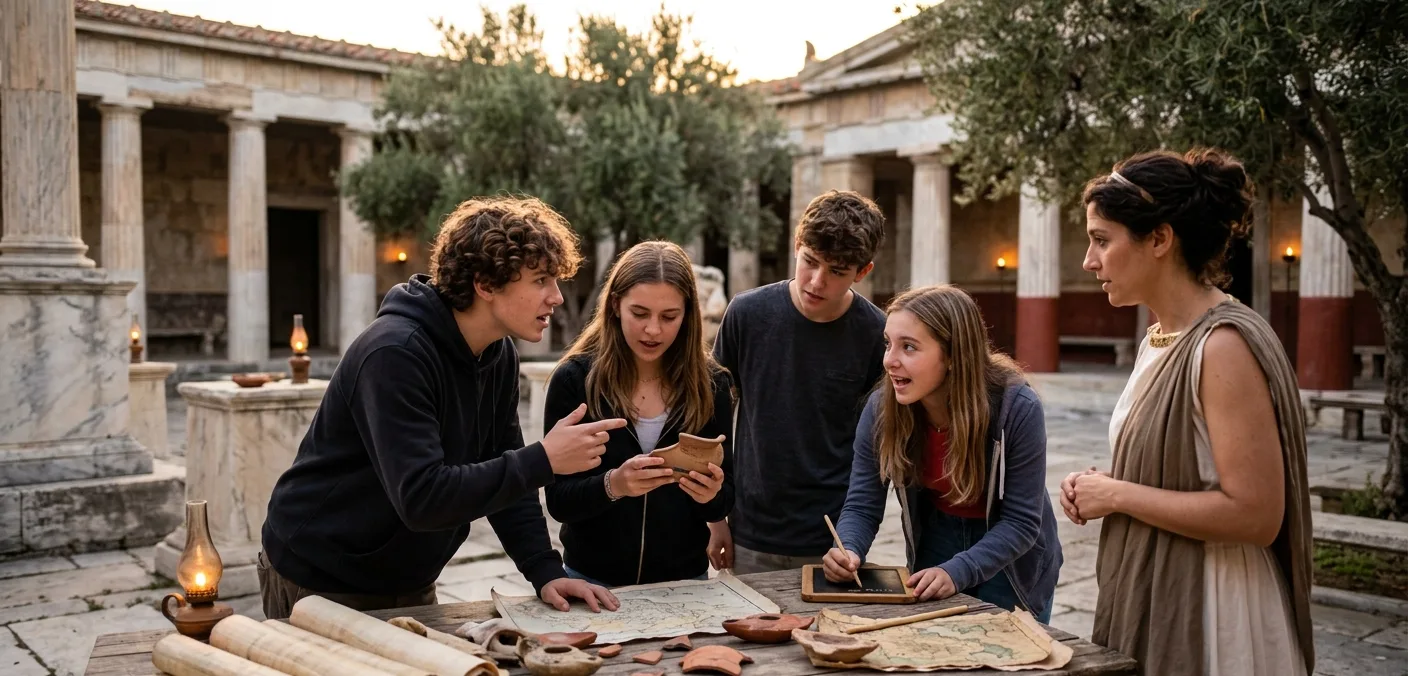
Who Killed Callimachos? is built on exactly the opposite principle. Your teenager arrives in ancient Athens as an investigator. A real murder mystery unfolds, guided by a professional actor, and the group must weigh evidence, question motives, and reach a conclusion together. Ancient Greek law, daily life, and political culture are all embedded in the story, but teenagers absorb them because they are too busy being detectives to notice they are learning.
The moment a teenager argues their theory with genuine conviction is the moment ancient Greece stops being a school subject and starts being something real.
The Psychology Behind Curiosity and Engagement
Curiosity is not a fixed character trait. It is a response to the right conditions: novelty, challenge, narrative, and stakes. Most history presentations offer none of these. A murder mystery offers all four.
When your teenager is trying to figure out who killed Callimachos, they are also absorbing what the agora was, how Athenian law worked, why the Battle of Marathon matters, and what daily life in ancient Greece actually looked like. None of that information is presented as something to remember for a test. It arrives as context for a story they are actively participating in.
Visit the Athens Living Museum experiences to see current availability and book the right session for your family group’s schedule.
What Happens When Teenagers Weave
The theatrical weaving workshop might sound like an unlikely hit with teenagers, but it consistently surprises parents. There is something about working with your hands that lowers resistance. Teenagers who would roll their eyes at a lecture about ancient Greek women find themselves genuinely absorbed in the story of Arachne as they work a loom for the first time.
The myth of Arachne is also perfectly calibrated for teenage sensibilities: an exceptionally talented mortal, challenged a powerful authority, and suffered the consequences. It is a story about pride, skill, competition, and consequence. Teenagers get it immediately. The craft gives their hands something to do while their minds engage with the story, and the combination tends to produce the quietest, most focused teenagers their parents have seen all trip.
They also leave with something they made, which matters more than it might seem. A physical object connected to a myth they experienced firsthand is a very different souvenir from a fridge magnet.
Food as a Gateway to History
Teenagers who claim to have no interest in history almost always have an interest in food. Around Greece in Five Dishes starts with something they already care about and layers history and culture into the experience through live performance and storytelling.
Five regional dishes arrive across the evening, each accompanied by an explanation of its cultural and geographic origins. Folk music plays between courses. A performer guides the table through the culinary history of Greece in a way that feels conversational rather than educational. Teenagers who spent the afternoon glazing over at the Acropolis Museum are frequently the most engaged people in the room by the second course.
Food gives them an entry point. The storytelling does the rest.
Theatre on the Streets: Athens Comes Alive at Night
Theatre on the Move is the experience that makes Athens feel like a living city rather than an open-air museum. A professional actor performs scenes from ancient Greek plays at real locations as your group moves through the city. The streets are the stage. The history is right there, in the buildings around you, but it is no longer static.
For teenagers, the evening format works particularly well. Athens at night has energy. Being part of a moving, performing group rather than standing in a queue makes the whole thing feel closer to an adventure than a school trip. Parents consistently report that this is the experience their teenagers bring up first when talking about the trip afterward.
Read through the Athens Living Museum blog for more detail on individual experiences, ages, timings, and what to expect from each session before you book.
Making the Most of Athens as a Family
The most common feedback from families who book these experiences is that they wish they had known about them before planning the rest of the trip. Not because the Acropolis or the National Archaeological Museum are not worth visiting they absolutely are but because the balance matters.
Teenagers need agency in the itinerary. They need moments where they are doing something rather than being told something. They need experiences they can talk about on their own terms, not because a parent told them to pay attention.
Athens Living Museum’s experiences are all conducted in English, set in intimate spaces, and designed to be genuinely engaging for ages ranging from older children through adults. Private family bookings are available for those who prefer an exclusive session.
FAQ
What is the best Athens Living Museum experience for teenagers?
Who Killed Callimachos? tends to be the biggest hit with teenagers because of its detective structure and active participation format. The Theatrical Weaving Workshop is also popular with teenagers who enjoy creative activities.
What age is appropriate for Who Killed Callimachos?
The experience works best for teenagers aged 12 and up, though confident and curious younger children can also engage with it. The mystery format keeps older children focused in a way that passive experiences often do not.
Do teenagers need to know anything about Greek history before attending?
No prior knowledge is needed. The experiences are designed to be a starting point for curiosity, not a reward for people who already know the subject.
How long are the experiences, and will teenagers stay engaged throughout?
Most experiences run two to three hours. The interactive, story-driven format is specifically designed to maintain engagement throughout, and most teenagers report that the time passed faster than they expected.
Are private family bookings available?
Yes. Private bookings can be arranged for families who prefer an exclusive experience. Contact Athens Living Museum directly to discuss dates and availability.
Is Athens Living Museum suitable for school groups?
Yes. The experiences are used by school groups as well as family travelers, and the interactive learning format aligns well with educational goals around ancient history and classical culture.
